A warped HDPE cutting board can rock under a knife, trap scraps, and make a familiar kitchen task feel unsafe. The fix is not always a dramatic one. Heat, uneven cooling, and storage against a hot surface can all contribute to distortion, but the board’s thickness and shape matter too. This guide explains how to fix a warped hdpe cutting board with careful, gradual steps—and when replacement is the wiser choice.
Material context helps. PlasticsEurope’s Plastics—The Fast Facts 2024 reports that global plastics production reached 413.8 million tonnes in 2023. That figure describes the wider plastics industry, not cutting boards specifically, so it should not be treated as proof that every HDPE board responds the same way to heat. HDPE can soften when warmed; uncontrolled heat may worsen a bend or damage the surface. Go slowly. Check the board often.
A trustworthy, verifiable quotation from a named specialist specifically about repairing warped HDPE cutting boards is difficult to establish. Rather than invent one, this introduction keeps the advice grounded in material behavior and practical inspection. Look for deep knife grooves, cracks, persistent rocking, or a board that will not lie flat after cooling. Small imperfections deserve attention, too. A home repair may improve a slight warp, but it cannot restore every board to its original condition. The steps ahead focus on controlled warmth, even pressure, and realistic expectations.
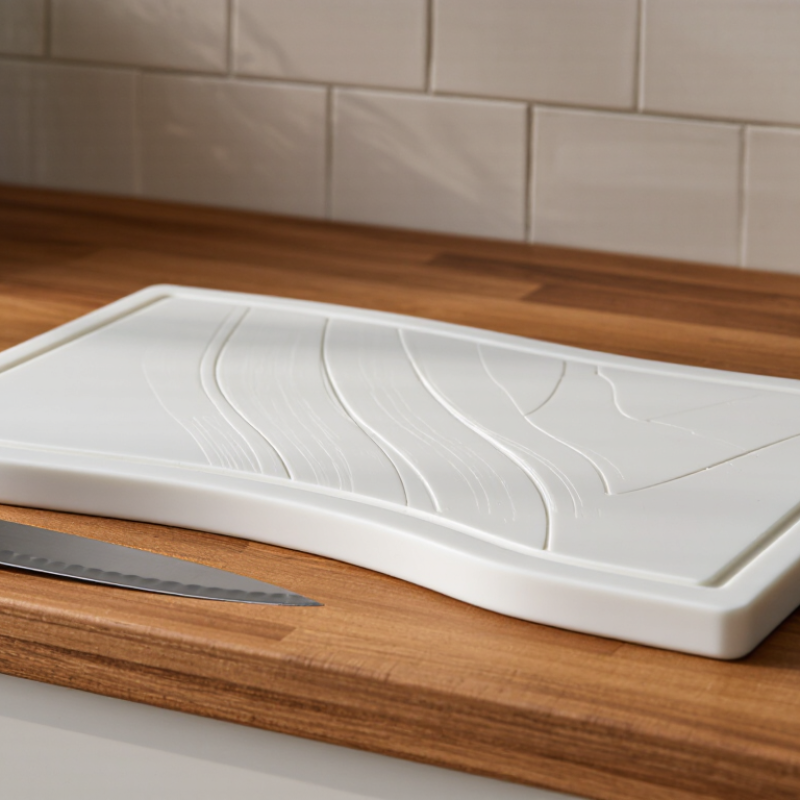
A warped HDPE cutting board usually points to uneven heat or mechanical stress, but the pattern offers clues. A curled edge or shallow “dish” shape often follows uneven heating or cooling; a twist can suggest uneven support or pressure while the board was warm. Check it on a known-flat counter. Press each corner, then measure the largest gap with a ruler or feeler gauge. It may help to mark the high side, though that measurement alone cannot reveal the cause.
Temperature history matters. The Plastics Pipe Institute’s Handbook of PE Pipe reports a thermal expansion coefficient of about 1.0 × 10⁻⁴ inch per inch per °F for polyethylene. That figure is a useful material reference, not a cutting-board guarantee: thickness, grade, and internal stress can change how a board moves. Think back to hot dishwasher cycles, contact with a hot pan, or storage against a warm surface. ASTM D648 describes a standard method for measuring heat deflection under load; its results depend on the tested material and conditions, so they should not be treated as a universal safe-use temperature. A slight bow that sits stable may be cosmetic. Rocking, a growing gap, cracks, or a board that slips during cutting are more serious. I would not guess from appearance alone. Check flatness again after the board reaches room temperature, and compare the measurement over time.
Before trying to flatten the board, inspect both faces and all four edges under bright light. Look for cracks, deep knife grooves, rough patches, or areas that trap residue. Set it on a level counter and press each corner; a small, even bow may be manageable, but rocking or a raised edge can make cutting unstable. ASTM D696-based engineering data sheets commonly report HDPE thermal expansion around 100–200 μm/m·°C, so heat can change its shape. It can also make the board warp again.
A home check cannot certify food-contact safety. The FDA Food Code 2022 requires food-contact surfaces to be smooth, durable, and easily cleanable, and equipment to remain in good repair. If a crack catches a fingernail, or a groove stays visibly dirty after washing, replacement is the safer choice. Stop there. Don’t sand away a deep defect and assume the surface is safe; that judgment is imperfect.
How to Fix a Warped HDPE Cutting Board in 2026?
How to Apply Controlled Heat to Restore a Flat Surface
A warped HDPE cutting board may respond to gentle, even heat, but results vary with its thickness and damage. Start with a clean, dry board on a stable counter. Check for deep cuts or cracks; heat will not repair structural damage. Go slowly.
Warm the board evenly with hot water, turning it so both sides receive similar exposure. Avoid boiling water, open flames, and concentrated heat from a heat gun. These can soften one area too quickly or leave the surface uneven. The board should feel warm and slightly more flexible, not limp. Use heat-resistant gloves.
Place the warm board between two clean, flat boards, then add an even weight across the top. A heavy, stable pan can work. Let the sandwich cool completely before removing the weight. Check it twice. If the board still rocks, repeat with gradual heat rather than pressing harder. In my experience, small bends are more likely to improve than sharp folds. Stop if the surface feels gummy, changes texture, or develops a strong plastic odor. Replace a board that remains unstable or has cracks, since a flat appearance alone does not restore its integrity.
| Stage | What to Do | Practical Guidance | Why It Matters |
|---|---|---|---|
| 1. Check the board | Wash and dry the board, then place it on a known-flat countertop. Check for rocking or gaps. | Record which edge or corner lifts. If the board is cracked, deeply grooved, or badly distorted, replace it rather than trying to reshape it. | Damage and severe warping may not be safely or reliably corrected with heat. |
| 2. Prepare a flat surface | Set out two clean, flat, heat-resistant boards or panels larger than the cutting board. | Use smooth surfaces that will not mark the plastic. Have several evenly distributed weights or clamps ready before heating. | Even, broad contact helps avoid creating new bends or pressure marks. |
| 3. Apply gentle, even heat | Warm the entire cutting board gradually using hot water or another controlled, uniform heat source. | A cautious starting range for hot water is about 60–70°C (140–158°F). Check the water with a thermometer and warm the board evenly; inspect it every few minutes. | HDPE softens with heat, but the response varies with board thickness, grade, and shape. Gentle heat is easier to control than a hot spot. |
| 4. Avoid concentrated heating | Do not direct a heat gun, open flame, or concentrated hot-air stream at one area. | Avoid an oven or microwave unless the board maker specifically approves that method and temperature. | Uneven heating can cause local deformation, surface damage, or burns. Typical HDPE melting temperatures are roughly 120–135°C (248–275°F), varying by material; do not use this as a target temperature. |
| 5. Flatten while warm | When the board is warm and slightly more flexible, place it between the prepared flat panels and apply even pressure. | Distribute weights across the surface or tighten clamps gradually. Use enough pressure to hold the board flat, without crushing or visibly marking it. | Even restraint helps the board cool in a flatter position. Results are not guaranteed, especially for thick or severely warped boards. |
| 6. Cool completely | Keep the board restrained until it has returned to room temperature. | Allow several hours as a practical cooling period; do not remove the weights while the board is still warm. | Releasing pressure too soon may allow the board to spring back toward its previous shape. |
| 7. Recheck and clean | Remove the restraints, check the board on a flat surface, then wash and dry it before food use. | If it remains noticeably warped, do not repeat with higher heat. Consider replacing it. | Repeated or excessive heating can damage the board, and a persistently unstable cutting surface can be unsafe to use. |
| Important safety note | Wear heat-resistant gloves when handling warm materials, keep hot water away from children, and follow any care instructions supplied with the board. Temperature and timing figures are cautious starting points, not a guaranteed repair specification. | ||
Once the board has been gently warmed and flattened, cooling evenly is the part that often gets rushed. Move it onto a clean, level surface. Place smooth, flat panels above and below it, with clean parchment between surfaces if needed. Add light, evenly spread weight, such as books distributed across the board. Avoid clamps or a single heavy object; concentrated pressure can leave dents or hold one area lower than another.
Keep the board undisturbed until it reaches room temperature. HDPE engineering data tables commonly report linear thermal expansion around 100–200 µm/m·°C, though values vary by grade. ASTM D696 describes a standard method for measuring plastics’ thermal expansion. That movement helps explain why uneven cooling can encourage a board to warp again. No need to rush. Avoid chilling it in a refrigerator or rinsing it with cold water, since rapid, uneven temperature change may work against a flat set.
Check it only after it feels cool throughout, not just at the edges. Lift the weight and inspect the board on a level counter. If it springs back, it may still hold internal stress; repeating the process is not guaranteed to fix it. I would rather use gentle, even pressure than force a stubborn corner flat.
After reshaping, let the HDPE board cool flat on a level counter before checking it. A warm board can appear straight, then bend again as it cools. For a repeatable check, ASTM D618 specifies conditioning plastics at 23 ± 2°C and 50 ± 10% relative humidity. Leave the board in a stable room for several hours, then place a straightedge across its center and corners. Measure any gap with a ruler or feeler gauge, and record the results. Repeat the check the next day. Small changes matter. A board that rocks, has raised edges, or traps food in deep grooves may not be reliably repaired. The FDA Food Code 2022, section 4-501.12, calls for cutting surfaces to remain smooth, durable, and easily cleanable.
Prevent another bend by storing the board flat, away from ovens, direct sunlight, and hot dishwasher interiors. Avoid leaning it upright while it is still warm or wet; uneven cooling can pull one edge out of plane. Wash both faces with warm water and mild detergent, then dry them before storage. I still recheck boards after a few weeks, because one flat measurement does not prove lasting stability. Keep a simple log of room conditions, gaps, and storage habits. If warping returns or the surface becomes difficult to clean, replace the board rather than trusting a temporary correction.
Repair verification: compare measured gaps before and after flattening. The figures below are illustrative example measurements, not a universal pass/fail standard.
How to verify: Place the board on a flat surface and check the center gap, corner lift, and rocking height with a ruler or feeler gauge. Recheck after the board has cooled and dried. To help prevent future warping, avoid prolonged high heat, wash according to care guidance, and store the board flat on a level surface.
Inspect both faces and all four edges under bright light. Look for cracks, deep grooves, rough patches, or trapped residue. Press each corner on a level counter. A slight, even bow may improve; rocking suggests instability.
Replace it if a crack catches your fingernail or a groove stays dirty after washing. Stop there. A home inspection cannot confirm food-contact safety.
Sometimes. Warm both sides evenly with hot water, turning the board as you go. It should feel warm and flexible, not limp. Results vary with thickness and damage.
Avoid boiling water, open flames, and concentrated heat from a heat gun. These can soften one spot too quickly and leave the surface uneven.
Place the warm board between two clean, flat boards. Add even weight, such as a stable heavy pan. Let it cool completely before checking. Don’t press harder if it still rocks.
Stop if the surface feels gummy, changes texture, or develops a strong plastic odor. Heat will not fix cracks or deep structural damage. I’d be cautious even if it looks flatter.
Let the board cool fully on a level counter. Check its center and corners with a straightedge, then note any gaps. Recheck the next day and again after a few weeks.
Store the board flat, away from ovens, direct sunlight, and hot dishwasher interiors. Wash both faces with warm water and mild detergent, then dry it. Avoid leaning it upright while warm or wet.
This guide explains how to fix a warped hdpe cutting board by first identifying what caused the distortion and how severe it is. Check whether the board is cracked, deeply damaged, or otherwise unsafe to repair; if so, replacement is the safer choice. For a board in suitable condition, use controlled, gentle heat to soften it gradually, avoiding sudden temperature changes that could worsen the warp or damage the material.
Once the surface is flexible, place the board on a flat, heat-safe surface and apply even pressure to restore its shape. Keep it secured and let it cool completely before removing the weight or clamps. Finally, check that the board sits flat and remains stable during use. To reduce the chance of future warping, avoid excessive heat, uneven storage, and placing the board near strong heat sources.
ProChef Kitchen