What does haccp color coding mean for cutting boards? It means assigning specific board colors to different food categories, such as raw meat, seafood, vegetables, or ready-to-eat foods. This visual system supports HACCP by reducing cross-contamination risks at preparation points. It does not replace cleaning, sanitizing, temperature control, or employee training.
Food safety expert Dr. Frank Yiannas has said, “Food safety is not a competitive advantage; it is a shared responsibility.” That principle matters in a busy kitchen. A red board may hold raw beef, while a green board handles washed produce. The colors must be clearly posted and consistently followed. Labels, storage racks, and staff demonstrations make the system easier to remember.
Small details matter. Keep boards on separate shelves. Inspect grooves after every shift. Replace boards when deep cuts cannot be cleaned properly. Record sanitation checks when your HACCP plan requires them. A color chart near the prep sink can prevent hesitation during a crowded service.
Still, color coding is not foolproof. A rushed worker can grab the wrong board. A clean-looking surface can still carry invisible hazards. This is where practical experience must challenge the written procedure. Review mistakes without blame, retrain staff, and adjust the workflow when needed. Local regulations and facility-specific HACCP plans may use different color assignments, so verify them with a qualified food safety professional. The goal is simple: make the safe choice visible, repeatable, and easier to inspect.
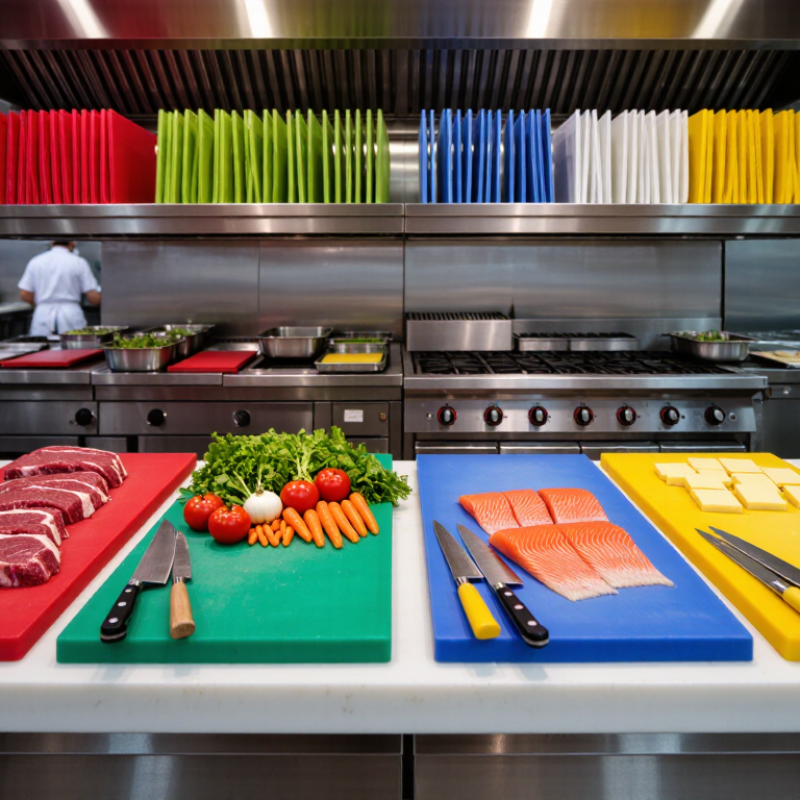
Understanding HACCP Color Coding for Cutting Boards
HACCP color coding helps food handlers separate tasks and reduce cross-contamination. However, HACCP does not require one universal color system. Each kitchen should document its own scheme, train staff, and display it near preparation areas.
A common system uses red for raw meat, blue for seafood, green for fruits and vegetables, and yellow for cooked foods. White may be assigned to bakery or dairy products. Purple can identify allergen-controlled preparation, but this depends on workplace policy. The color is only a visual control. Staff must still wash, rinse, sanitize, and inspect every board after use.
Think of a busy kitchen at noon. A green board holds sliced cucumbers, while a red board waits beside a raw-meat station. Keeping them apart is useful. Yet color alone cannot prevent mistakes. Similar shades may confuse new employees, and worn boards can hide deep grooves or stains. That weakness deserves attention.
A reliable procedure includes clear labels, separate storage, and regular staff checks. Boards should be replaced when cracks, heavy scoring, or persistent odors appear. Supervisors can record cleaning times and observe whether workers follow the scheme during busy periods. Color coding works best as one part of a broader HACCP plan, supported by hygiene training, temperature control, and accurate records. Local food safety requirements may differ, so the written procedure should be reviewed regularly.
How to Use HACCP Color Coding for Cutting Boards?
Assigning colors to specific food preparation categories makes separation easier during busy kitchen work. A practical system might use red for raw red meat, yellow for poultry, blue for seafood, green for fruits and vegetables, and white for ready-to-eat foods. Brown can identify cooked meats when this category needs its own board. Keep it simple.
The colors should match written procedures, storage labels, and staff training. A board used for raw chicken should never move to a salad station without proper cleaning and sanitizing. Store boards separately, preferably in marked slots, so wet surfaces do not touch one another. A quick visual check before preparation can prevent an expensive mistake.
HACCP color coding is a control measure, not a complete food safety program. Local requirements may differ, so the assigned categories should be reviewed against current workplace rules. No color system is foolproof. In practice, faded surfaces, poor lighting, or rushed staff can cause confusion. Clear symbols and large labels may help workers with color-vision differences. Supervisors should inspect boards regularly for deep cuts, stains, and damaged edges. Replace them when cleaning no longer restores a safe surface. A useful review asks one uncomfortable question: would a new employee understand the system without verbal help? If not, the arrangement needs refining.
Assigning one dedicated cutting board to each food-preparation category helps reduce cross-contamination. This chart shows a commonly used color convention; always align it with your local HACCP plan and food-safety requirements.
Each category represents one dedicated cutting-board allocation. Red is commonly used for raw meat, blue for raw fish and seafood, green for fruits and vegetables, yellow for cooked foods, brown for root vegetables, and white for bakery and dairy products.
Choosing and labeling cutting boards is a practical part of a HACCP-based food safety system. Color coding helps separate raw ingredients from ready-to-eat foods. However, color rules are not universal. Each kitchen should match its board colors with its written HACCP plan and local food safety requirements.
A clear label should state the intended use, such as “raw poultry,” “seafood,” or “ready-to-eat.” Use large, waterproof lettering on the board or its storage rack. Do not rely on color alone. A worker with limited color vision may miss the difference, especially under dim kitchen lighting. Keep matching knives, containers, and storage areas clearly marked.
Clean and sanitize boards after each task. Check them during every shift for deep grooves, stains, loose edges, or damaged labels. A scratched surface can hold residue, even when it looks clean. Replace it.
Training matters. During kitchen observations, I have seen employees return a board to the wrong rack after a busy service. The color system worked, but the storage layout did not. Separate racks, simple signs, and regular checks reduce that risk. Staff should also know that a board used for raw food cannot safely become a ready-to-eat board without proper cleaning and sanitizing. The system may still need adjustment.
How to Use HACCP Color Coding for Cutting Boards?
In a HACCP kitchen, color coding helps separate food groups and reduce cross-contamination. The colors are not universal. Follow the written chart used in your facility. A red board may be assigned to raw meat, while a green board may serve washed produce. Another kitchen may use different colors. Keep allergen controls separate and clearly documented. Color alone is not enough.
After each task, remove scraps immediately. Wash the board with hot water and approved detergent. Rinse it thoroughly. Apply the correct food-safe sanitizer at its required concentration. Let the board air-dry completely before reuse. Do not wipe it with a dirty cloth. I have seen staff rush this step during busy service. That shortcut creates doubt, even when the board looks clean. Inspect the surface daily for deep grooves, stains, or warping. Damaged boards should be removed from service.
Store boards vertically on a clean rack, with space between each one. Keep raw-food boards away from ready-to-eat equipment. Never stack wet boards together. Label storage spaces when colors are easy to confuse. A simple cleaning log can record the time, product, and staff initials. I still recheck the chart when a new color system is introduced. Memory is unreliable during a crowded shift. If a board touches the wrong food, stop, clean, sanitize, and document the incident. A short pause is safer than an unexamined assumption.
How to Use HACCP Color Coding for Cutting Boards?
Maintaining and Reviewing a Color-Coded HACCP System
A color-coded cutting board system supports HACCP by separating food preparation tasks. Assign each color to a specific food category, such as raw meat, seafood, vegetables, or cooked foods. Record these assignments in your food safety plan. Do not rely on color alone. Add clear labels, staff training, and storage rules. In a busy kitchen, a red board may sit beside a green one, but rushed workers can still choose incorrectly. That risk needs practical control.
Tips: Keep boards in separate, labeled storage slots. Inspect them at the start of each shift. Replace boards with deep grooves, cracks, or permanent stains. Clean and sanitize boards after each task, following your approved procedure. Use a simple inspection sheet. Note the date, board condition, and corrective action. Short records help reveal repeated problems.
Review the system regularly with supervisors and food handlers. Observe real preparation work, rather than checking paperwork alone. Ask whether colors remain visible under poor lighting. Confirm that new employees understand the assignments. Review the system after menu changes, equipment damage, or a contamination incident. A quarterly review may work, but higher-risk kitchens might need more frequent checks. Our process was not perfect at first; we discovered that identical storage racks caused confusion. Changing the rack layout improved compliance. Keep reviewing the system honestly, because a color code only works when people use it correctly.
| Board Color | Assigned Food Category | Typical HACCP Hazard Controlled | Examples of Use | Key Control Requirement |
|---|---|---|---|---|
| Red | Raw meat | Transfer of pathogens from raw animal products | Beef, pork, lamb and other raw red meats | Keep separate from ready-to-eat foods; clean and sanitize after use. |
| Orange | Raw poultry | Transfer of poultry-associated pathogens | Raw chicken, turkey and other raw poultry | Use only for raw poultry where possible; prevent contact with other raw foods. |
| Blue | Raw fish and seafood | Transfer of seafood pathogens and allergens | Raw fish, shellfish and other raw seafood | Control seafood allergens and keep the board away from ready-to-eat preparation. |
| Green | Fruit and vegetables | Cross-contamination between raw produce and other foods | Washed produce, salads, herbs and vegetables | Use for produce only after the board has been cleaned and sanitized. |
| Purple | Allergen-controlled preparation | Undeclared allergen transfer | Foods prepared for documented allergen-control procedures | Use only when supported by the site’s allergen management plan and verified cleaning controls. |
| Yellow | Cooked or ready-to-eat foods | Recontamination after cooking or washing | Cooked meat, prepared foods, bread and ready-to-eat items | Do not use after raw food contact unless the board is fully cleaned and sanitized. |
| Review or Maintenance Area | Required Action | Suggested Frequency | Acceptance Criteria | Corrective Action and Record |
|---|---|---|---|---|
| Color identification | Check that staff can identify the assigned use of each board. | At induction, refresher training and routine observation | Board color and food category match the documented site procedure. | Stop incorrect use, retrain the employee and record the training or deviation. |
| Physical condition | Inspect for deep knife grooves, cracks, warping, discoloration and difficult-to-clean surfaces. | Before use and during scheduled equipment inspections | Surface is smooth, intact, stable and cleanable. | Remove damaged boards from service, replace or professionally resurface them, and document the action. |
| Cleaning and sanitizing | Follow the approved sequence: remove food debris, wash, rinse, sanitize and air-dry. | After each food category change and whenever contamination occurs | Correct chemical, concentration, contact time and water temperature are used according to the approved procedure. | Re-clean and sanitize; verify the process and record failures in the sanitation log. |
| Storage and segregation | Store boards vertically or in separated holders so clean surfaces do not contact contaminated surfaces. | Daily operational check | Boards are dry, protected, identifiable and separated by designated use. | Rearrange storage, re-clean affected boards and document repeated problems. |
| Verification of sanitation | Review visual inspections and, where included in the food safety plan, use objective verification such as swab testing. | According to the documented verification schedule and after significant failures | Results meet the site’s defined limits and show that cleaning controls are effective. | Investigate the cause, revise procedures or training, and retain verification results. |
| HACCP system review | Confirm that color assignments still match the menu, workflow, hazards, equipment and allergen controls. | At least annually and whenever products, processes, equipment or regulations change | The procedure remains suitable, staff understand it and records demonstrate implementation. | Update the hazard analysis, SOPs, signage and training records; approve the revision. |
Note: Color assignments are a practical segregation method, not a substitute for an approved HACCP plan, effective cleaning and sanitizing, employee training, or applicable food safety requirements.
Color coding helps separate food categories during busy preparation. It can reduce cross-contamination risks. Color alone is not enough.
No, color assignments differ between kitchens. Follow the facility’s written chart, labels, and training materials. Check the chart again when procedures change.
One system may use red for raw meat, yellow for poultry, blue for seafood, and green for produce. White may identify ready-to-eat foods. Brown can identify cooked meats. Your workplace may use different assignments.
Remove scraps immediately. Wash the board with hot water and approved detergent. Rinse it thoroughly. Apply food-safe sanitizer at the required concentration. Let it air-dry completely.
Store boards vertically on a clean rack. Leave space between them. Keep raw-food boards away from ready-to-eat equipment. Never stack wet boards together.
Use large labels, clear symbols, and marked storage slots. These details help during poor lighting or rushed shifts. They may also support workers with color-vision differences.
Inspect it daily for deep grooves, stains, warping, and damaged edges. Replace it when cleaning no longer restores a safe surface. A stained board deserves closer attention.
Stop using it immediately. Clean, rinse, sanitize, and document the incident. Do not rely on appearance alone. A short pause is safer.
Ask whether a new employee understands it without verbal help. If not, the arrangement needs improvement. That uncomfortable question can reveal weak training.
No. Keep allergen controls separate and clearly documented. Color coding supports procedures, but it cannot replace them. Mistakes remain possible.
HACCP color coding for cutting boards is a practical system that helps separate food preparation tasks and reduce the risk of cross-contamination. If you are asking, “what does haccp color coding mean for cutting boards,” it refers to assigning different colors to boards used for specific food categories, such as raw meat, seafood, vegetables, cooked foods, or ready-to-eat ingredients. The exact color assignments should be clearly defined by the food service operation and communicated to all staff.
Safe use also depends on more than color selection. Each board should be labeled, kept in good condition, and used only for its assigned category. Staff should follow proper cutting procedures, wash and sanitize boards after use, and store them in a clean, dry location that prevents contact between different food-preparation tools. Regular inspections, staff training, and periodic reviews of the color-coded HACCP system help ensure that procedures remain consistent, practical, and effective.
ProChef Kitchen