What is the best cutting board for expensive Japanese knives? The answer depends on more than price or appearance. A thin, hard-edged gyuto can feel precise on one surface and unforgiving on another. Think of the board beneath it: the knife’s edge meets that surface with every slice, from a ripe tomato to a firm carrot. Small details matter.
Master bladesmith Bob Kramer is often credited with the advice, “A sharp knife is a safe knife.” The board matters, too. A stable surface helps you cut with control, while a board that is too hard may contribute to faster edge wear. Wood, rubber, and synthetic materials each feel different under the blade. None is perfect. That’s worth remembering.
This guide compares seven cutting boards for cooks who want to protect costly Japanese knives without turning dinner preparation into a chore. We consider surface feel, stability, maintenance, size, and practical value. A hinoki board may offer a gentle, traditional feel, while a rubber board can be easier to maintain in a busy kitchen. Your counter space matters. So does how often you are willing to oil or wash a board. These picks are not a substitute for careful knife technique, and personal preference still counts. We’ll explain the trade-offs clearly, so you can choose a board that suits your knife, your kitchen, and the way you actually cook.
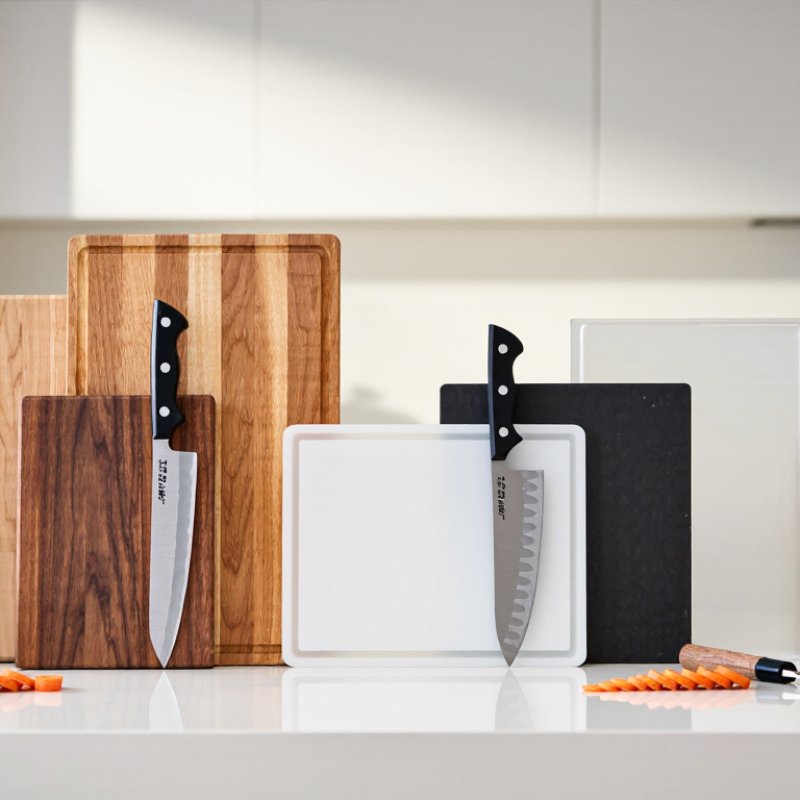
Many Japanese kitchen knives sit around 60–65 HRC, a hardness range that helps them hold a keen edge but can make them less forgiving of impact. HRC measures hardness, not toughness; blade geometry and steel also matter. Still, a knife at this level deserves a cutting surface that yields slightly under the edge. Wood and quality plastic are practical choices. Glass, stone, and ceramic boards are hard enough to accelerate edge wear and raise the risk of tiny chips. That risk is easy to overlook.
Listen while chopping. A sharp, ringing click against a hard board is a warning, not proof of damage, but it is worth noticing. Softer boards usually produce a quieter, gentler contact. Keep the board stable with a damp towel underneath, and avoid twisting the blade through dense food. Small habits matter. Wood needs drying and occasional care; plastic can develop deep grooves that are difficult to clean thoroughly. Neither option is perfect, and board material alone cannot prevent dulling. Cutting angle, pressure, and the food itself all play a part. A board that feels comfortable, stays flat, and cleans easily is more useful than one chosen for appearance alone.
Japanese kitchen knives commonly fall in the 60–65 HRC range, though hardness varies by blade. A harder edge can be more prone to chipping under impact; board choice, cutting technique, and blade geometry also matter.
| Rank | Board Type | Edge Friendliness | Practical Advantages | Care and Trade-Offs | Best Use |
|---|---|---|---|---|---|
| 1 | End-Grain Maple | Very high. The cutting surface exposes the wood fibers’ ends and is comparatively forgiving to a fine edge. | Stable, durable, and suitable for frequent chopping when properly maintained. | Heavy and often thick. Hand-wash, dry promptly, and condition with food-safe board oil as needed. Avoid soaking. | A primary work surface for premium knives and regular kitchen prep. |
| 2 | Hinoki Cypress | Very high. Its relatively soft wood provides a gentle-feeling surface for fine edges. | Lightweight and easy to handle; a traditional Japanese-style wood option. | Can dent and show knife marks. Hand-wash, dry thoroughly, and store with airflow to limit warping or moisture problems. | Careful slicing of fish, vegetables, and other delicate ingredients. |
| 3 | End-Grain Walnut | High. The end-grain construction is forgiving; walnut is generally less hard than many dense cutting-board woods. | Comfortable for repeated cutting and visually distinctive without requiring a hard surface. | Can be heavy and may show stains less clearly on its darker surface. Hand-wash and dry promptly; do not leave it wet. | A premium, knife-conscious all-purpose board. |
| 4 | Edge-Grain Maple | High. A sound, smooth hardwood surface is suitable for knives, though it generally feels firmer than end-grain construction. | Durable and often thinner and lighter than a comparable end-grain board. | Knife marks accumulate with use. Hand-wash, dry promptly, and periodically apply food-safe board oil if recommended for the board. | A sturdy everyday wooden board when end-grain construction is impractical. |
| 5 | Resilient Rubber | High. Its resilient surface can cushion cutting impact and is widely used for knife-focused food preparation. | Offers a stable cutting feel and is less prone to splintering than wood. | Weight, cleaning requirements, and dishwasher suitability vary by material and construction. Follow the maker’s care instructions. | Frequent prep when a resilient, non-wood surface is preferred. |
| 6 | Food-Grade HDPE Plastic | Moderate to high. It is more forgiving than glass or stone, but feels firmer than many wood or rubber boards. | Nonporous and easy to clean. Some boards are dishwasher-safe; check the product’s care instructions. | Deep knife grooves can retain food residue and are difficult to clean fully. Replace a board that is badly scored or damaged. | Practical, easy-clean prep, especially when a replaceable board is useful. |
| 7 | Bamboo | Moderate. Bamboo boards can feel comparatively hard and may be less forgiving to a fine edge than softer wood or rubber. | Lightweight, widely available, and generally resistant to moisture-related swelling when cared for properly. | Construction and surface hardness vary. Hand-wash, dry promptly, and avoid using a heavily worn or rough board with a fine edge. | A secondary or budget-friendly board; choose a smooth surface and use controlled cutting technique. |
Many sit around 60–65 HRC. This hardness can help an edge stay sharp, but it does not measure toughness.
Wood and quality plastic usually yield slightly under the blade. End-grain wood and quality rubber can feel forgiving during slicing.
These surfaces are very hard and may speed edge wear or contribute to tiny chips. A sharp click is a warning sign, not proof of damage.
No. Maple measures about 1,450 lbf on the Janka scale, while walnut measures roughly 1,010 lbf. Walnut may feel gentler, but neither rating guarantees edge performance.
Plastic is easy to wash thoroughly. Use separate boards for raw meat, poultry, seafood, and ready-to-eat foods.
Dry it upright after washing, and give it occasional care. End-grain construction may absorb some impact, but it still needs maintenance.
Replace it when deep grooves are difficult to clean. Small grooves happen; deep ones deserve attention.
Keep the board stable with a damp towel underneath. Avoid twisting the blade through dense food. Small habits matter. I still sometimes forget.
Choosing a surface for a fine Japanese knife means balancing edge wear, stability, hygiene, and upkeep. Since many Japanese blades measure about 60–65 HRC, a hard or abrasive board can contribute to faster edge wear. Hard maple, at roughly 1,450 lbf on the Janka scale, is firmer than walnut at about 1,010 lbf, but hardness alone does not determine whether a board is suitable. The question “what is the best cutting board for expensive japanese knives” depends on the knife steel, the kind of food preparation, and how much maintenance the owner is willing to do.
This comparison considers seven board types, including their impact on edges, resistance to movement, cleanliness, and care requirements. Softer, knife-friendly surfaces may need regular washing, drying, or conditioning, while synthetic and other alternatives have different trade-offs. Any board should be kept clean and stable, and deeply scored surfaces should be assessed for replacement; FDA Food Code §4-501.12 provides a benchmark for when cutting surfaces become too worn to be effectively cleaned and sanitized.

 ProChef Kitchen