When preparing vegetables, many people choose plastic cutting boards labeled BPA-free. The label sounds reassuring, but it answers only one question. It indicates that bisphenol A was not intentionally used in the product’s plastic formulation. It does not prove that every additive, coating, or replacement chemical is harmless.
So, are bpa-free plastic cutting boards actually safe? In everyday use, they can be a practical choice when manufactured for food contact and maintained correctly. Food-safety agencies assess approved materials, but product quality still varies between manufacturers. A thin board from an unknown source may provide less reliable information than a certified, clearly labeled product. Look for food-contact statements, care instructions, and a manufacturer willing to identify the material.
Your cutting habits matter, too. A board can develop narrow grooves after months of chopping carrots, chicken, or crusty bread. Those marks may trap moisture and food residue. Wash the surface with hot, soapy water after use, then dry it upright. Replace the board when deep cuts remain difficult to clean, or when it becomes warped, cracked, or rough.
BPA-free does not mean risk-free. It is a limited claim.
Some replacement chemicals deserve attention. Current research continues to examine how different plastics behave under heat, abrasion, and repeated washing. I would not treat one label as a complete safety guarantee. A sturdy board, transparent sourcing, careful cleaning, and timely replacement offer a more realistic approach. Reconsider the board when its surface tells a different story.
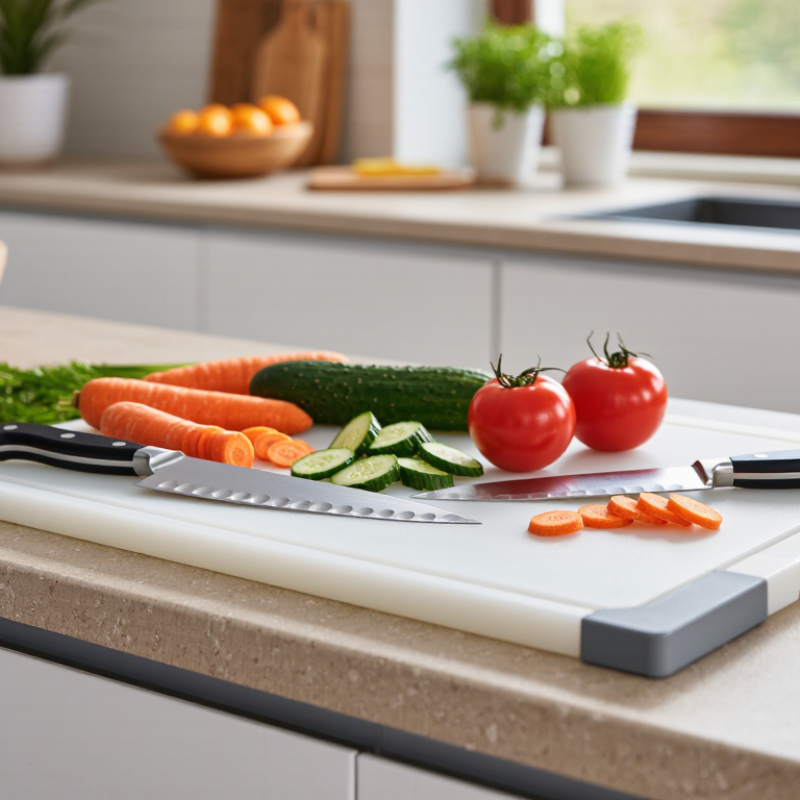
BPA-free is a narrow chemical claim, not a complete safety certificate. It usually means the manufacturer did not intentionally use bisphenol A, or the product meets a defined detection threshold. It does not mean the board contains no additives, dyes, plasticizers, or processing residues. Other chemicals may replace BPA, and labels rarely explain them clearly. That gap matters.
The European Food Safety Authority’s 2023 scientific opinion reviewed more than 800 studies and reduced its tolerable daily intake for BPA to 0.2 nanograms per kilogram of body weight daily. That limit is 20,000 times lower than its previous value. However, this assessment covers dietary exposure broadly, not one plastic cutting board. The United States Food and Drug Administration continues to assess approved food-contact uses using migration and toxicity data. Neither report proves that every BPA-free board performs identically.
Look closely at the surface. A heavily scored board can hold moisture, onion fibers, and microscopic food residue. Washing removes dirt, but it cannot restore a worn cutting surface. Heat, harsh chemicals, and prolonged soaking may also accelerate aging. Replacing BPA with another compound may reduce one concern while leaving another unanswered. That is the uncomfortable part. A BPA-free label is useful, but incomplete. In practical kitchen use, a smooth, intact board and careful cleaning probably matter as much as the label. I would not treat either factor as perfect.
| Safety Dimension | What the Evidence Indicates | Practical Takeaway |
|---|---|---|
| Meaning of “BPA-Free” | The product is marketed as not being made with intentionally added bisphenol A (BPA), a chemical used in some polycarbonate plastics and epoxy resins. | It addresses BPA specifically; it does not certify that the board contains no other additives or chemicals. |
| BPA exposure from a cutting board | Exposure depends on the board’s material, formulation, condition, temperature, and contact with food. Normal food-contact use is generally expected to produce low exposure when the product complies with applicable regulations. | Use the board according to its instructions and avoid using damaged or unapproved plastic products for food preparation. |
| BPA-free does not mean chemical-free | BPA-free plastics may use different polymers, additives, colorants, stabilizers, or processing aids. The safety of these substances must be assessed separately. | Treat “BPA-free” as one limited claim rather than a complete safety certification. |
| Food-contact compliance | A food-contact cutting board should be made from materials intended for food use and should meet the relevant regulatory requirements in the country where it is sold. | Look for clear food-contact labeling, care instructions, and manufacturer documentation rather than relying only on a marketing phrase. |
| Microplastic and particle concerns | Repeated knife cuts can create grooves and may release small plastic particles. The health significance of ingesting particles from household cutting boards is still being studied. | Replace boards that are deeply scratched, cracked, warped, or shedding visible material. |
| Bacterial contamination | Deep cuts and difficult-to-clean surfaces can retain food residue and microorganisms. Cleaning effectiveness depends on the board’s condition and the cleaning method. | Wash thoroughly after use, allow the board to dry completely, and replace it when the surface can no longer be cleaned effectively. |
| Heat and dishwasher use | Heat can deform some plastics and may increase the migration of certain substances under specific conditions. Dishwasher suitability varies by material and product design. | Do not place a board in a dishwasher or expose it to high heat unless the care instructions specifically allow it. |
| Cross-contamination control | The main everyday food-safety risk is often the transfer of pathogens between raw meat, poultry, seafood, produce, and ready-to-eat foods. | Use separate boards, or clean and sanitize the surface between raw and ready-to-eat foods. |
| Material identification | A recycling symbol or plastic identification code describes a resin category; it does not by itself prove that a specific cutting board is safe for food contact. | Prioritize food-contact labeling and product instructions over the recycling number alone. |
| Overall assessment | A BPA-free plastic cutting board can be a reasonable food-preparation option when it is designed for food contact, properly maintained, and replaced when damaged. The BPA-free label alone is not a guarantee of overall safety. | Choose a reputable food-contact product, follow care instructions, maintain good hygiene, and inspect the surface regularly. |
Note: “BPA-free” describes the absence of intentionally added BPA; it does not establish that every alternative material or additive is risk-free.
No. It means one specific chemical was excluded or replaced. Other additives may remain. BPA-free is useful information, not a safety certificate.
Migration becomes more likely with heat, oil, acidity, and long contact. Warm roasted vegetables on a soft board create more concern than cool dry bread.
Deep scratches can trap moisture, food residue, and bacteria. Narrow grooves are difficult to clean completely. Replace boards with rough patches or deep cuts.
Yes. Heat may warp the surface and create cracks or raised edges. A warped board can also slide during chopping. Avoid unnecessary heat.
Yes. Separate boards reduce cross-contamination between raw meat, seafood, and prepared foods. Color coding helps, but memory can fail.
Wash it with hot, soapy water after every use. Dry it upright, away from damp counters. Follow the manufacturer’s cleaning instructions.
Replace it when deep grooves, splitting, loose flakes, strong odors, or persistent roughness appear. If cleaning no longer restores a smooth surface, replace it.
Not always. Well-maintained wood may reduce plastic contact, but it needs careful cleaning and complete drying. Wood is not maintenance-free.
It may create uneven wear and additional surface damage. I once kept worn boards for convenience. That choice was practical, but not especially careful.
The question “are bpa-free plastic cutting boards actually safe” depends on more than the absence of BPA. BPA-free means the product was made without bisphenol A, but it may still contain other additives, and safety can vary according to the type and quality of plastic used. Common materials include polypropylene and high-density polyethylene, which are generally chosen for food contact because they are durable and relatively resistant to moisture. However, chemicals may migrate into food, especially when the board is exposed to high temperatures, oily foods, strong detergents, or prolonged wear.
Scratches and deep cuts can trap bacteria and make the surface harder to clean, while heat can accelerate material breakdown. To choose a safer board, look for clear food-contact information, a sturdy surface, and appropriate thickness. Wash it thoroughly after each use, allow it to dry completely, avoid excessive heat, and replace it when it becomes deeply scratched, warped, cracked, or difficult to clean.

 ProChef Kitchen